The Art Museum in the Digital Age: Tour with Eva Fischer
Now in its eighth edition, the international online conference examined the complex relationships between truth, false and manipulated information, and the authority of knowledge in the context of digital transformation processes. In an age of growing disinformation, AI-generated content, and algorithmic bias, museums are being challenged to rethink their role as trusted spaces of knowledge mediation. At the same time, digital technologies are opening up new possibilities for participation, contextualisation, and translation. A keynote, four thematic online sessions, an in-person workshop, and a panel discussion explored current developments, ethical tensions, and concrete case studies. At the centre of the conference was the question of how museums can assume digital responsibility and actively contribute to an open and reflective information culture.
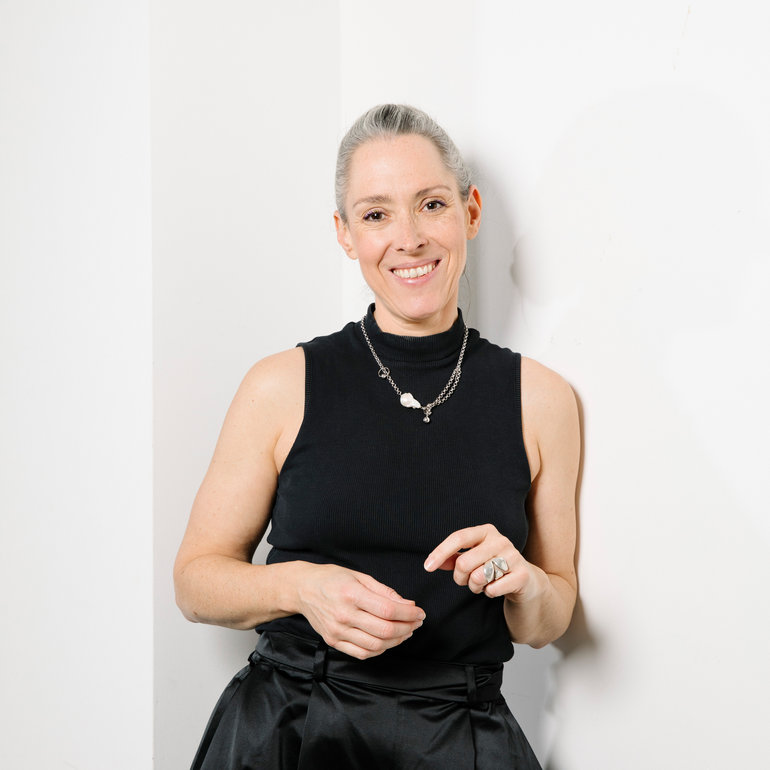
During the guided tour with Eva Fischer, our students learned how key concepts of quantum physics can be translated into artistic forms. Scientific principles were made tangible through the double-slit experiment, Schrödinger’s cat, and the ideas of superposition and entanglement. Exhibits that changed colour depending on the viewing angle made the influence of perspective immediately perceptible. A mirror object in which the faces of two people standing opposite each other visually merged invited participants to rethink perception and identity. A cooperative video game, in which two participants overcame obstacles back-to-back and were ultimately reunited through a black hole, translated abstract physical concepts into a playful experience. This was complemented by engagement with an atomic clock sealed in a time capsule in Africa, as well as by an animated film whose open-ended interpretation challenged the students’ capacity for reflection. Altogether, they experienced how interactive and multisensory formats can make scientific subjects more accessible and stimulate curiosity.

The subsequent panel focused on the origin, selection, and validation of digital information. Our students came to understand that the museological emphasis is increasingly shifting from the contemplation of individual objects to the critical examination of sources. Traceability emerged as a central category: it must be transparent who decides which data are made accessible to artificial intelligences and which are deliberately excluded. The goal is not to simulate aura, but to make chains of sources visible. This requires documented selection processes, transparent distinctions, and framing that is appropriate to different audiences, especially for less experienced users. Artificial intelligence was discussed as an analytical medium capable of structuring institutional knowledge. At the same time, there was a growing awareness of the need to disclose access conditions, assumptions, and limitations, particularly in relation to dynamic online collections.
Practical insights into the use of AI in the cultural sector deepened this perspective. Using the example of the AI-supported reconstruction of destroyed works by Gustav Klimt, our students recognised that such results should be understood as expert-guided approximations that open up debate rather than claiming final truth. It also became clear how essential clean and consistent metadata are for digital collections and applications. Work on the Künstlerhaus Experience App showed that curated content will increasingly be evaluated by systems capable of reading relationships and contexts. Such agents are based on clear curatorial decisions that must be documented and open to review.
From the conference, our students drew two central conclusions. First, complex scientific content becomes particularly accessible when it is explored through interaction, shifts in perspective, and shared experience. Second, in the digital age the museum is not only an exhibition space, but also an infrastructural actor within the knowledge ecosystem. It curates data, makes source pathways transparent, and applies artificial intelligence in a methodologically controlled way. This also increases the importance of user competencies: media literacy, source literacy, and orientation skills are becoming key qualifications that museums and universities must develop together.
From the perspective of our students, the art museum in the digital age thus emerges as both a laboratory and a space of learning. It combines aesthetic experience with methodological rigour, makes the origins and validity of knowledge transparent, and uses AI where it enables analysis rather than imitating aura. In this interplay, an open and reflective dialogue between art, science, and the public becomes possible—one that is both well grounded and forward-looking.
Text: Maximilian-Friedrich Wimazal


